
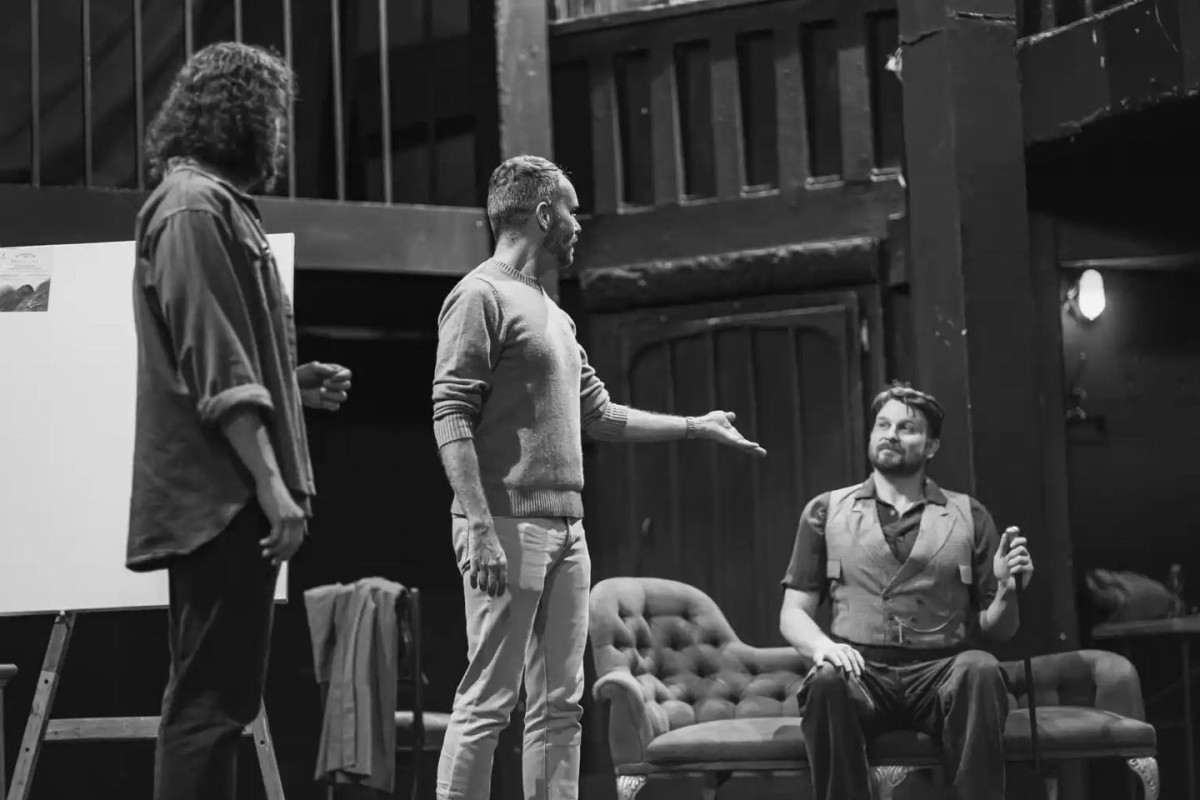
Is there anyone that doesn’t know the twist to The Picture of Dorian Gray? Oscar Wilde’s gothic novel has such an assured place in our culture, that it should give a theatrical adaptation a lot of licence.
This script from Merlin Holland – Wilde’s grandson – and John O’Connor restores the overtly queer plotting that the novella’s original editor removed as too scandalous for the time, particularly artist Basil’s love for Gray.
Drew Ramsbottom is exemplary as Basil (and a later side role as the opium addled Adam Singleton), bringing to life the nervousness of forbidden love, and a quiet dejection at his poor treatment by his friends.
That includes Sir Henry Wotton, portrayed with charming chamber pitch by Robert Minshew. Wotton’s characterisation in the script is, however, minimal, instead performing as a walking quote book with dialogue consisting almost entirely of Wilde’s witticisms. There is nothing wrong with Minshew’s delivery of them, but the writers’ desire to stuff in as many aphorisms as possible ends up resembling a sort of toff stand up set.
As Gray, Jose Tarouca has a bit more to work with and his portrayal noticeably hardens from our original introduction to the innocent gentleman, through his aborted first love, to the cruelty of the final scenes. He also copes admirably with a very odd scene exploring decadence through luxurious fabrics, which could have been very happily cut to trim the two and three-quarter hour run time.
There are several doubled-up ensemble roles, with William McKinnell covering five brief roles and managing to give them all something distinct; Susan Seddon switching from aristocrat to drug peddlar; Gill Tichborne having fun queening it up as the Duchess; and Brooke Elley as Lady Wotton, among others.
Maggie Harding is a suitably radiant Sibyl Vane – at least until her (deliberately) bad portrayal of Juliet, which is neatly staged with McKinnell.
As director and production designer, Claire Stretton makes some good use of projection to switch between scenes and show the passage of time, with Andrew Jay’s portrait artwork hauntingly degrading on screens behind the action.
The production faithfully tells the restored story, but perhaps does so too slavishly. Wilde’s frequent Shakespearean references remind us that a good story can stand up to a lot (although I’m still not quite over the RSC’s recent Hamlet on a boat).
With such a strong core story, and a society that has moved on its mores, this could have been shorter, braver, and a better use of the talents in the room.
- The Picture of Dorian Gray continues at the Maddermarket Theatre, Norwich, until 28 June 2026. Tickets £10.50-£16.80.