
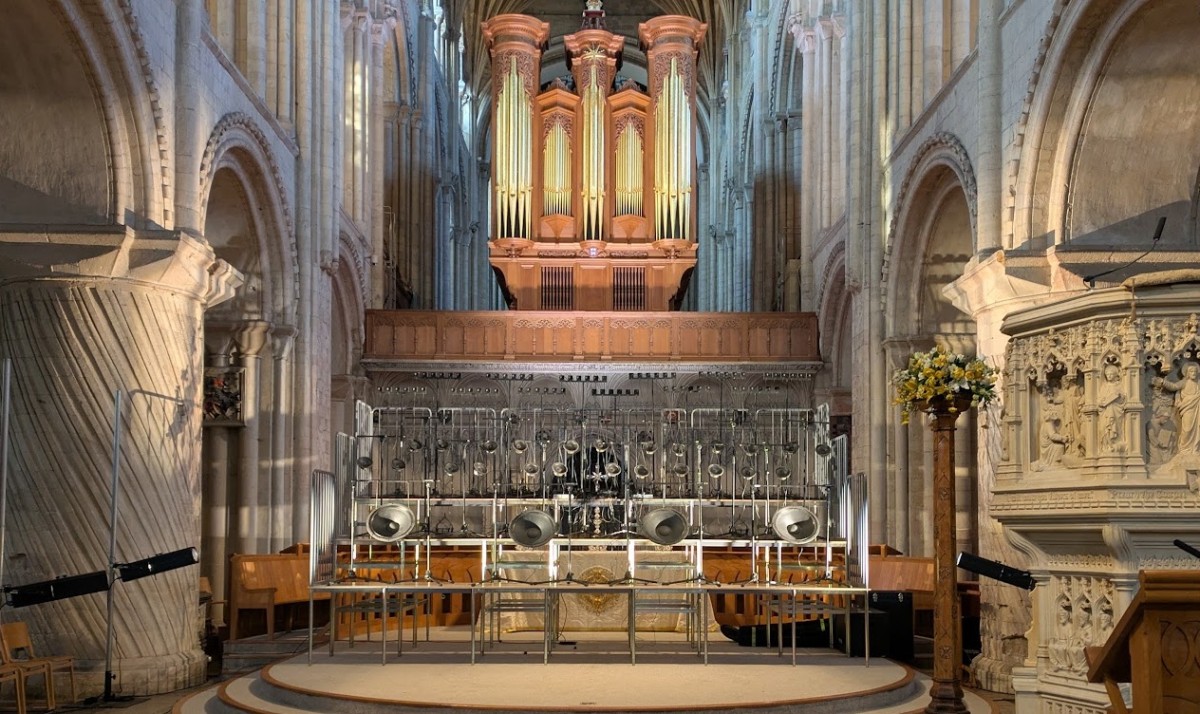
The grand pipes of Norwich Cathedral’s organ have probably never had an accompaniment quite like this: 100 1-bit speakers, complimenting and competing with it.
The array of naked speakers makes for an imposing sight in front of the golden majesty of the permanent instrument, but organist and Norfolk and Norwich Festival artist in residence James McVinnie and composer Tristan Perich are nowhere to be seen during the hour-long performance.
If you’re not sure what a 1-bit speaker is, think the alarm of an 80s Casio watch; this is intentionally primitive. The programme notes make a case for the similarities between the two sound sources: both are binary, with the pipes and speakers making single notes, either on or off. But the reality is the two are far apart – and for me at least, I’d rather they had stayed that way.
While there is clear artistry here, and there’s always value in experimentation, sometimes experiments fail. The oscillating soundscapes deliberately fight each other and that makes for a difficult listen, and one that ultimately is not rewarded enough for the discomfort they generate.
The piece is deliberately minimalist, with few discernible melodies and only occasional rhythm – we do get some pulses of deep bass in one section, repetitively scratching white noise in another, but this more about mass of sound than musicality.
In maths an infinity gradient is a way of describing a vertical line, like a brick wall. On one side is an interesting intellectual experiment, and a speaker array. On the other is lyricisim.
- Infinity Gradient was performed at Norwich Cathedral on Saturday 9 May 2026, as part of the Norfolk and Norwich Festival